As development continues on the NF3D Trident proof-of-concept, one question naturally comes up:
Is a 48-volt motion system actually worth it?
More specifically:
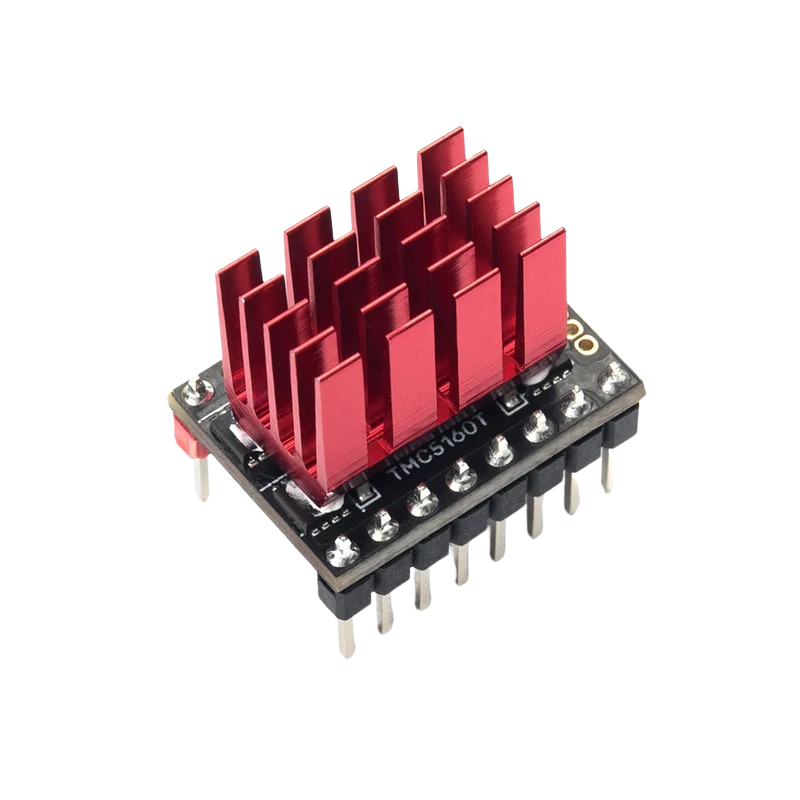
Do TMC5160 Pro drivers running on a 48V rail provide meaningful real-world advantages over TMC2209 drivers on a 24V system?
The short answer is yes, but the benefits are specific and the trade-offs are real.
This article explains the true engineering advantages of 48V motion, when those advantages matter, and what you give up when moving to a more complex high-voltage system.
Voltage and Stepper Performance
Stepper motors do not simply “spin faster when voltage is increased.”
Instead, voltage determines how quickly the driver can push current into the motor coils. This becomes critical as speed increases and the motor’s inductance rises.
Higher voltage allows the driver to:
- maintain torque at higher speeds
- push current into the coils faster
- respond more quickly to direction changes
- reduce the chance of skipped steps
- improve high-frequency motor performance
In a 3D printer motion system, these electrical characteristics translate into:
- higher achievable speeds
- stronger acceleration
- cleaner motion during rapid direction changes
- reduced ringing
- better control of 0.9° motors at speed
In short:
Higher voltage gives the driver more electrical headroom to maintain controlled, accurate motion.
Why TMC5160 Drivers Benefit From 48V
TMC2209 drivers are excellent for 24V hobby and prosumer printers, but they are not optimized for high-voltage operation and cannot take advantage of the electrical benefits that come with it.
TMC5160 Pro drivers, on the other hand, offer:
- native support for up to 60V
- higher peak and RMS current
- superior back-EMF handling
- external MOSFETs and sense resistors for improved thermal performance
- higher current rise time, which significantly benefits 0.9° motors
- cleaner electrical behavior during high-speed operation
These properties matter most when pushing a motion system beyond typical consumer-grade limits.
A dual-gantry system is one of those situations.
Real-World Advantages in a Printer
Below are the improvements you actually see when running a motion system on 48V with TMC5160-class drivers.
Higher Speed With Usable Torque
A 24V system can reach high speeds, but torque drops quickly.
48V allows torque to remain available at significantly higher speeds.
Stronger, Cleaner Acceleration
Acceleration is where print time is gained or lost.
Voltage improves the driver’s ability to push current into the motor quickly, especially during rapid reversals.
Better for Dual-Gantry Motion
A system with two toolheads contains rapid, overlapping changes in direction and load.
Voltage helps maintain stability and prevents step loss in these challenging conditions.
Cleaner Motion and Reduced Ringing
Higher voltage improves the driver’s ability to counteract oscillations, leading to cleaner corners and smoother curves.
Cooler Motor Operation
Higher voltage can improve overall system efficiency, reducing heat in the motors at equivalent performance levels.
The Downsides of a 48V System
A 48V motion system is not appropriate for every printer.
There are real trade-offs to consider.
More Complex Wiring
Instead of a single voltage rail, you now have:
- a 48V rail for motors
- a 24V rail for hotends, fans, and CAN
- possibly a 5V rail for logic
- grounding and isolation requirements
Boards designed for mixed-voltage operation, like the Octopus Pro H723, make this safer and simpler, but it is still more complex than a 24V system.
Voltage Compatibility
If you wanted everything to run at 48V, you would need:
- 48V heater cartridges
- 48V fans
- 48V-compatible CAN boards
- wiring rated for the voltage
Most builders, including NF3D for this POC, use 48V only for motors and run everything else at 24V using a buck converter.
Increased Cost
The jump to 48V requires:
- more expensive drivers
- a board capable of handling high voltage
- additional wiring and power distribution considerations
It is not a budget-friendly upgrade.
When 48V + TMC5160 Is Worth It
This configuration is ideal when:
- running 0.9° motors
- pushing high acceleration values
- using a heavier or more complex gantry
- experimenting with dual-gantry systems
- building a printer with long belt paths
- tuning for high-speed, high-resolution printing
- performing motion research and development
These are exactly the conditions present in the NF3D Trident POC.
When It Is Not Worth It
A 48V motion system is usually unnecessary for:
- light gantry printers
- low-speed or mid-speed printing
- budget builds
- printers already limited by mechanical rigidity
- systems using 1.8° motors and conservative acceleration
- any build not requiring extreme motion performance
Voltage does not fix mechanical problems; it only enhances a motion system that is already mechanically solid.
Why NF3D Is Testing 48V in the Trident Proof-of-Concept
The NF3D Trident POC is a development platform designed for:
- dual-gantry motion
- heavy toolheads
- 0.9° motors
- high acceleration testing
- experimental motion choreography
- increased frame rigidity
- precise, validated CAD-to-print engineering
- pushing motion systems into territory typical hobby printers do not reach
In this context, a 48V motion system paired with TMC5160 drivers is not an overbuild.
It is the correct tool for the job.
The increased electrical performance directly supports the mechanical and motion-system goals of this prototype.