48V – Dual Voltage 3D Printer
For years, most hobby and prosumer 3D printers have relied on 12V or 24V motion systems. They work well, they’re inexpensive, and they’re widely supported — but they also come with unavoidable limitations. As FDM printers have grown faster and more capable, those limitations have become harder to ignore.
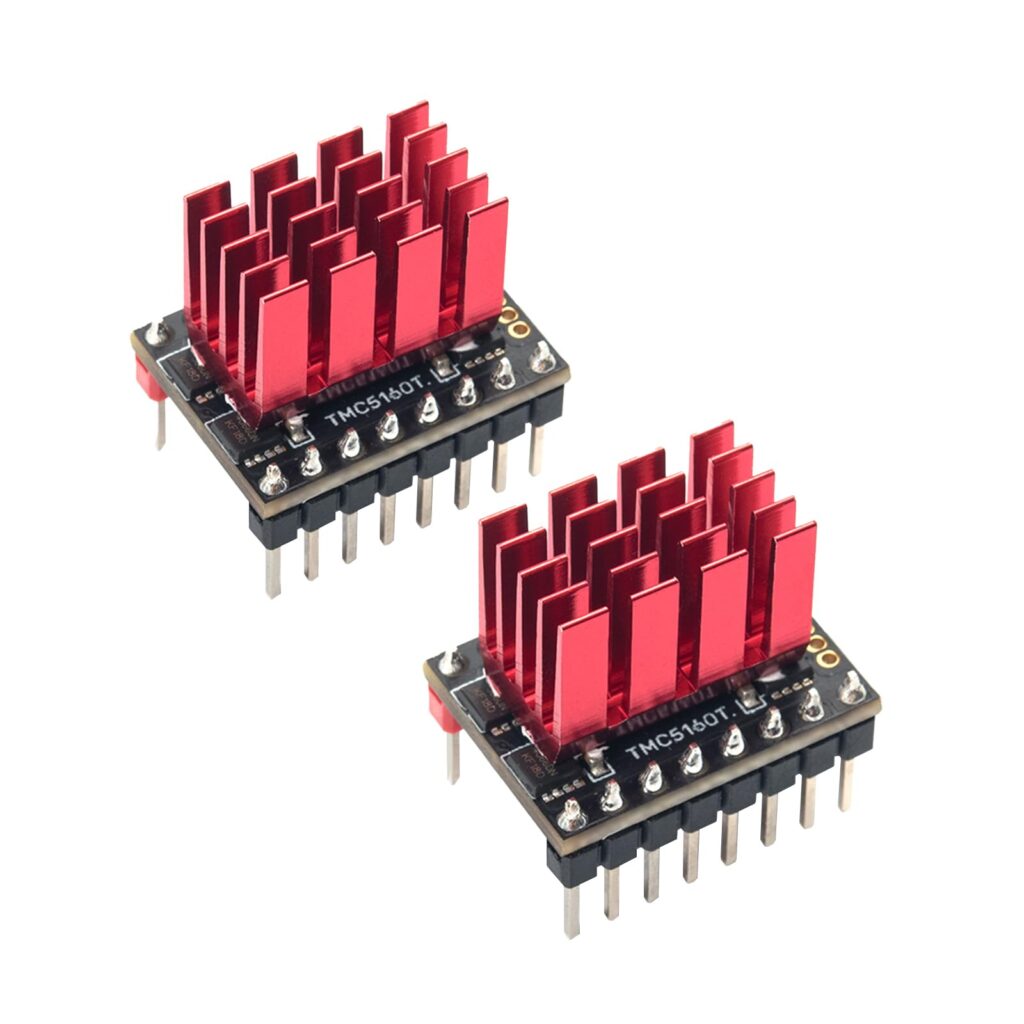
For the first NorthForge3D Trident build — our fully modded, experimental test platform — we’re stepping into something most printers don’t do: a dual-voltage motion system with 48V rails, powered by TMC5160 drivers on a BTT Octopus Pro H723 board. This isn’t a gimmick or an attempt to be “cutting-edge for the sake of it.” Other high-end modders and industrial machines have used 48V motion for years.
This is about one thing:
Building a printer that can push performance boundaries cleanly, safely, and predictably.
If you want to follow the build, the full project is being documented here:
https://github.com/NorthForge3D/Northforge3D-Trident
Before we talk about benefits, let’s start with the honest part — the tradeoffs.
The Tradeoffs: Why Doesn’t Everyone Use 48V?
1. Cost
The biggest reason 48V motion isn’t mainstream is simple:
TMC5160 drivers cost more than TMC2209s.
A set of 5160s is easily 2–3× the price of 2209s, and you need a mainboard that supports higher voltage rails. For a budget-oriented printer, that’s simply not the best place to spend money.
2. More Complex Wiring
A 48V system isn’t complicated, but it is more involved than plugging in a 24V power supply and calling it done. You must:
- supply motion drivers with 48V
- safely isolate 48V from your 24V heater zones
- use proper buck converters for fans, LEDs, and accessories
- follow good grounding practices
Again: not difficult — just not entry-level.
3. Diminishing Returns Without the Rest of the Machine
Throwing 48V at a wobbly frame, a heavy toolhead, or mediocre belts doesn’t magically solve anything.
The machine must be built to take advantage of the higher-voltage motion:
- rigid frame
- proper linear rails
- low-mass toolhead
- strong belts and clean routing
- high-quality steppers (in our case: custom 0.9° motors)
Otherwise, you might see speed gains, but not precision gains.
So Why Use 48V?
Because once your machine has a strong mechanical foundation, 48V becomes a cheat code.
Here’s the part that matters:
Stepper motors produce less torque at higher speeds.
Higher voltage compensates for that loss.
At 24V, a stepper’s torque starts falling sharply as RPM increases. That sets a ceiling on:
- maximum acceleration
- maximum travel speed
- maximum print speed
- how clean corners look at high speed
- how well the printer holds position during fast direction changes
At 48V (or even 56V), torque stays usable much, much longer. That translates directly into better motion quality.
What 48V Actually Improves
1. Faster Acceleration Without Losing Steps
Torque drop-off at high speed is the biggest cause of skipped steps during aggressive accelerations.
48V systems maintain torque deeper into the speed curve, meaning:
- higher accelerations are stable
- less chance of layer shifts
- cleaner movement during fast direction changes
For CoreXY and IDEX systems, this is a huge deal.
2. Cooler Stepper Motors
This surprises people, but it’s true.
When a stepper isn’t fighting against voltage limits, it runs more efficiently. Less electrical strain = less heat.
A properly tuned 48V system often runs:
- cooler motors
- cooler drivers
- more consistent torque
- less magnetic saturation
Cooler motors = longer life and less thermal drift.
3. Smoother Motion at Higher Speeds
TMC5160 drivers are simply more capable when dealing with fast, high-torque movement.
More voltage = cleaner transitions between microsteps = smoother motion.
This leads to:
- fewer vibration artifacts
- more stable input shaping
- better corner consistency
- improved surface quality at speed
It’s not “faster printing for the sake of faster printing.”
It’s maintaining quality while printing faster.
4. More Accurate Micro-Motion at High Speed
When a printer is moving slowly, almost any voltage works fine.
When it’s moving fast — carving out complex geometry — the motor needs voltage headroom to respond to micro-movements precisely.
Higher voltage lets the stepper reach microsteps cleanly, instead of rounding or skipping them under load.
This is where 24V machines start to feel sloppy at high speed.
48V machines stay crisp.
5. Voltage Headroom for Future Experiments
This is a big part of why the NorthForge3D test Trident is going 48V from day one.
We want room to experiment.
Running TMC5160 Pro drivers means we aren’t limited to 48V — we can go to 56V for testing if the rest of the system is safe and ready for it.
That doesn’t mean the final consumer printer will run at 56V, but it gives us space to:
- test motion limits
- tune resonance profiles
- evaluate high-speed micro-motion
- understand real torque curves on our 0.9° motors
Engineering isn’t guessing — it’s testing.
So What’s the Real Benefit for an End User?
Simple:
- More reliable high-speed printing
- Less noise and vibration
- Better corner accuracy
- Reduced ringing
- Fewer skipped steps
- Cooler-running motors and drivers
- More consistent print quality over long prints
48V doesn’t turn a bad printer into a good one.
But it does let a well-built machine reach its potential.
And that’s exactly what the first NorthForge3D Trident is being built for:
a platform to perfect motion, test ideas, and push the boundaries of what an FDM machine can do — cleanly and predictably.
If you want to follow along, you can find the build logs, design notes, and testing data here:
https://github.com/NorthForge3D/Northforge3D-Trident